What Is Trading? A Plain-English Beginner’s Guide

Trading is buying and selling financial assets — currencies, shares, commodities — to profit from changes in their price. Buy low and sell higher, or sell high and buy back lower, and the difference is your gain (or loss). This guide explains, in plain English, how trading works, what you can trade, how it differs from investing, and how to start.
What is trading?
Trading is the act of buying and selling financial instruments to profit from price movements. A trader doesn’t need to own a business or hold an asset for years — they aim to profit from the price moving, over minutes, days, or weeks.
Every trade has two sides: you open a position (buy or sell) and later close it. If the price moves your way between those two points, you profit; if it moves against you, you lose. That simple mechanic underlies every market in the world.
Trading vs investing
People mix these up, but they’re different:
| Trading | Investing | |
|---|---|---|
| Time horizon | Minutes to weeks | Years |
| Goal | Profit from price swings | Grow wealth slowly |
| Direction | Long or short | Mostly long (buy & hold) |
| Style | Active, frequent | Passive, patient |
| Typical instruments | Forex, CFDs, stocks | Shares, index funds |
- Investing is long-term. You buy assets — usually shares or funds — to hold for years, aiming to grow wealth slowly through appreciation and dividends.
- Trading is shorter-term and more active. You aim to profit from price swings over a much shorter horizon, and you can profit from prices falling as well as rising.
Investing is a marathon; trading is a series of sprints. Neither is “better” — they’re different tools.
What can you trade?
You can trade almost any liquid market. The main ones:
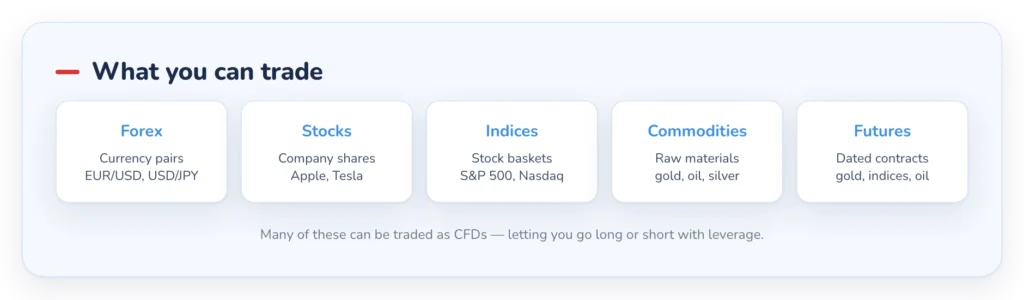
- Forex — currency pairs like EUR/USD, GBP/USD, and USD/JPY; the largest, most liquid market.
- Stocks — shares of individual companies such as Apple or Tesla.
- Indices — baskets of stocks, like the S&P 500, Nasdaq 100, or FTSE 100.
- Commodities — gold, silver, oil, and other raw materials.
- Futures — standardized contracts to buy or sell an asset at a set price and date.
Many of these can be traded as CFDs, which let you go long or short with leverage — explained in our CFD trading guide.
How does trading work?
Three ideas cover most of it:
- Going long or short. Buy (go long) if you expect the price to rise; sell (go short) if you expect it to fall. Being able to profit both ways is a key difference from simple investing.
- The spread. The small gap between the buy and sell price is your main cost on each trade.
- Leverage. Many markets let a small deposit control a larger position. It magnifies gains and losses, so it must be handled carefully.
Say you buy a share at $100 and sell at $110 — you make $10 per share, minus costs. Sell first at $110 and buy back at $100, and you make the same $10 on the way down.
What does trading cost?
Every trade has costs, and they decide how much of your profit you keep:
- The spread — the gap between the buy and sell price, often a fraction of a percent on a liquid market like EUR/USD and wider on thin ones. On a $10,000 position, a 0.1% spread costs about $10 to open.
- Commission — some markets, especially share CFDs, add a fee of around 0.1% of the trade on top of the spread.
- Overnight financing — leveraged positions held overnight carry a small daily charge.
Costs are small per trade but add up fast if you trade often — one reason over-trading quietly erodes returns.
The main trading styles
Traders differ by how long they hold a position:
- Day trading — positions opened and closed the same day. See day trading for beginners.
- Swing trading — held for days to weeks.
- Position trading — held for weeks to months.
- Scalping — dozens of tiny trades held for seconds or minutes.
The risks — and how to start
Trading can be profitable, but most beginners lose money at first. Prices are unpredictable, leverage amplifies losses, and emotion drives bad decisions. The traders who last manage risk relentlessly: small size, a stop-loss on every trade, and a tested plan.
To start: learn the basics, practice on a demo account, then trade small with real money. Tradeview Markets offers demo and live trading on the MetaTrader and cTrader platforms, and our how to start trading guide walks through every step.
Be clear-eyed: trading is high-risk. You can lose money, including more than you deposit when using leverage. Only trade money you can afford to lose.
Frequently asked questions
What is trading in simple terms?
Buying and selling assets to profit from price changes. You buy expecting a rise (or sell expecting a fall) and close the position later for a gain or a loss.
Is trading the same as gambling?
No — though it can become gambling without discipline. Skilled trading relies on a tested edge and strict risk management, not luck. Trading on impulse, with no plan, is closer to gambling.
How much money do I need to start trading?
Less than most people think — many brokers let you start small, and demo accounts are free. What matters is risking only what you can afford to lose and starting with tiny position sizes.
Can you make a living trading?
A minority do, after years of practice and discipline. Most people who try do not. Treat it as a skill to build slowly, not a quick income.
What is the easiest market for beginners?
Many start with forex (especially EUR/USD) for its liquidity and low costs, or with major stocks for their familiarity. The best choice is one market you focus on and learn deeply.
Sources
- Barber, B. M., & Odean, T. (2000). Trading Is Hazardous to Your Wealth: The Common Stock Investment Performance of Individual Investors. The Journal of Finance, 55(2), 773–806. doi.org
- Bank for International Settlements (2025). Triennial Central Bank Survey — OTC foreign exchange turnover in April 2025. Global FX turnover reached $9.6 trillion per day. bis.org
Risk warning. Trading Forex and CFDs carries a high level of risk and may not be suitable for all investors. Leverage can work against you as well as for you. This article is for educational purposes only and does not constitute financial advice. Only trade money you can afford to lose.
Community
Trading platforms
Services
Articles
Community
Trading platforms
Services




Copyright © 2026. All rights reserved.
There is a risk of loss in trading foreign currencies and it is not suitable for everyone. Tradeview is not responsible for any gains or losses on currency rates or exchanges during any transaction.
The services and products offered by Tradeview are not being offered within the United States (US) and not being offered to US Persons, as defined under US law. The information on this website is not directed to residents of any country where FX and/or CFDs trading is restricted or prohibited by local laws or regulations.
CFDs are complex instruments and come with a high risk of losing money rapidly due to leverage. 64% of retail investors' accounts lose money when trading CFDs with Tradeview. You should consider whether you understand how CFDs work and whether you can afford to take the high risk of losing your money.
Headquarters Tradeview Ltd.: 13 Genesis Close, 4th Floor, Suite 422, Cayman Islands
High Risk Warning: Foreign exchange trading carries a high level of risk that may not be suitable for all investors. Leverage creates additional risk and loss exposure. Before you decide to trade foreign exchange, carefully consider your investment objectives, experience level, and risk tolerance. You could lose some or all your initial investment; do not invest money that you cannot afford to lose. Educate yourself on the risks associated with foreign exchange trading and seek advice from an independent financial or tax advisor if you have any questions.
Advisory Warning: Tradeview provides references and links to selected blogs and other sources of economic and market information as an educational service to its clients and prospects and does not endorse the opinions or recommendations of the blogs or other sources of information. Clients and prospects are advised to carefully consider the opinions and analysis offered in the blogs or other information sources in the context of the client or prospect's individual analysis and decision making. None of the blogs or other sources of information is to be considered as constituting a track record. Past performance is no guarantee of future results and Tradeview specifically advises clients and prospects to carefully review all claims and representations made by advisors, bloggers, money managers and system vendors before investing any funds or opening an account with any Forex dealer. Any news, opinions, research, data, or other information contained within this website is provided as general market commentary and does not constitute investment or trading advice. Tradeview expressly disclaims any liability for any lost principal or profits without limitation which may arise directly or indirectly from the use of or reliance on such information. As with all such advisory services, past results are never a guarantee of future results.